Physics, Math, or Engineering? How do you decide
When I was a child, I spent a lot of time in industrial halls and at trade fairs instead of sitting in classrooms. My father studied electrical engineering first and then mechanical engineering. He worked on differential dosing scales early in his career and later moved to Degussa, where he designed complete process engineering plants. By his forties he was responsible for planning and realizing large industrial facilities, both in Germany and in China.
One of the things that always impressed me was that he started building plants in Shanghai already in 1979. When he showed me the old photographs, the China in those pictures looked almost unrecognizable compared to today. He witnessed and helped shape that transformation over more than two decades. I could feel how much pride and responsibility came with that kind of work.
He took me to my first major trade show when I was six years old. I think it was the “K” in Düsseldorf. He asked some of his colleagues to take me around and explain the machines to me. From that day on I often went to work with him, sometimes even skipping school. I was completely fascinated by how machines could perform tasks that were too heavy, too hot, or too dangerous for any human, and do them with astonishing speed and precision. That early exposure shaped something deep in me. I did not just want to understand machines. I wanted to be part of the world that builds them.
How I Ended Up Studying Three Different Fields
So when the time came to choose a subject, mechanical engineering felt like the obvious and only reasonable choice. After I graduated as a state-certified engineer, I began to feel that my real strengths might actually lie in electrical engineering. While I was studying for my bachelor’s degree in electrical engineering, a friend passed me a job opportunity at Puls Plasma Technik in Dortmund. That job brought me into contact with high-voltage and pulsed-power equipment used at places like CERN, GSI, COSY, and DESY. Standing in front of those systems, I suddenly understood that I did not just want to build machines anymore. I wanted to understand the fundamental physics that made such extreme machines possible in the first place. That was the moment particle physics became unavoidable for me.
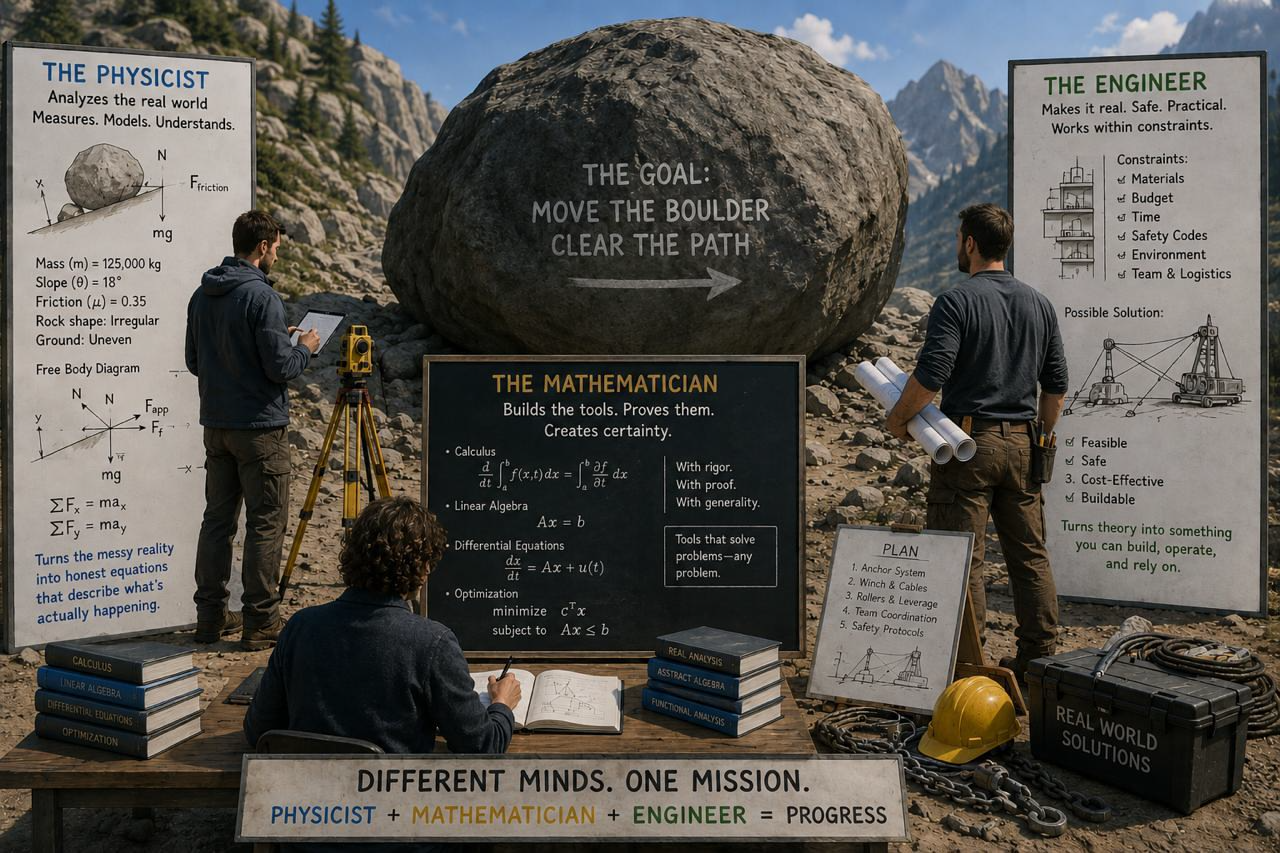
Over the years, a simple model formed in my mind that helps me explain to myself and to others how physics, mathematics, and engineering actually relate to each other. I like to tell it with a picture.
Physics, Mathematics, and Engineering: A Model That Finally Made Sense
Imagine a large boulder lying in front of a mountain. Three people are asked to move it to the other side. In technology we usually solve problems like this by doing something that reminds me of the Laplace transform. We take a difficult, messy real-world problem and project it into a cleaner, more abstract space where it becomes easier to handle. We solve it there, and then we bring the solution back into reality.
The physicist is the person who stands in front of the boulder and tries to understand what is actually going on. They measure forces, friction, the shape of the ground, the mass distribution, and all the other relevant conditions. Their job is to create a faithful mathematical description of the situation. They turn the physical reality into a set of equations that capture the essential behavior of the system.
Once you have those equations, you usually cannot solve them with everyday thinking. This is where the mathematician comes in. Mathematicians do not primarily care about the boulder. They care about building reliable intellectual tools. Differentiation, integration, linear algebra, differential equations, statistics, transforms. These are all tools that mathematicians develop, refine, and, most importantly, prove to work within clearly stated boundaries. Their work is the only part of the process where you can achieve real certainty, because mathematics allows you to argue rigorously about correctness.
After the mathematician has done their work, you usually end up with design guidelines or constraints expressed in mathematical language. These guidelines do not yet tell you how to move the boulder. They only tell you what any successful solution must respect. This is where the engineer takes over. The engineer has to read those mathematical results and invent a concrete, workable system that satisfies all the constraints while also being buildable with real materials, real budgets, real people, and real safety requirements. In a sense, the engineer performs the physicist’s work in reverse. They start from abstract requirements and turn them into something you can actually touch and use.
All three roles are necessary, and they are genuinely different.
Which Field Suits You? The Honest Differences
If you are the kind of person who feels deep satisfaction when you manage to prove that something must be true in every possible case, and you enjoy spending long hours working with almost nothing but paper, ink, and precise language, then mathematics is probably the right field for you. You need patience and a love for rigor.
If you enjoy the struggle of taking something messy and real, measuring it carefully, finding patterns, and then expressing those patterns in mathematical form, physics will probably feel exciting to you. You get to live between the real world and the mathematical world.
If you enjoy mathematics and physics but become happiest when you can actually build something that works, when you like working with constraints, when you enjoy the creative act of finding practical solutions that are good enough even if they are not perfect on paper, then engineering is likely where you belong.
Why Switching Degrees Is Not a Failure
One thing that often confuses students is that the first years of study in these fields look quite similar. Most engineering programs start with mechanics, basic electronics, and mathematics. Most physics programs start with mechanics, electromagnetism, optics, and thermodynamics. Mathematics begins with analysis and linear algebra. Because of this overlap, many people feel uncertain or even guilty when they switch directions after one or two years. I think that feeling is usually unnecessary. Switching can simply mean that you are getting to know yourself better. You can only guess what a field will actually feel like from the outside. If you discover after some time that you are on the wrong train, getting off at the next station is not a failure. It is information.
The most important question is not which label you choose first. The important question is whether you are genuinely interested in understanding how things work and in contributing to the technological world we live in. If you enjoy solving difficult problems, if you are fascinated by the fact that a single person or a small group of people can create things that change what is possible for everyone else, and if you are willing to keep learning for the rest of your life, then you are probably in the right broad area.
The specific door you walk through first matters less than most people think. What matters more is whether you stay honest with yourself about what actually energizes you as you go deeper.
If you are standing in front of this decision this summer, try not to put too much pressure on yourself to get it perfectly right on the first attempt. Almost everyone who works seriously in these fields had to adjust their path at some point. There are very few truly wasted years if you do the work with real curiosity and to the best of your abilities.
If you want to talk about it, come find me on Discord.