Are Machines Conscious? A Snapshot
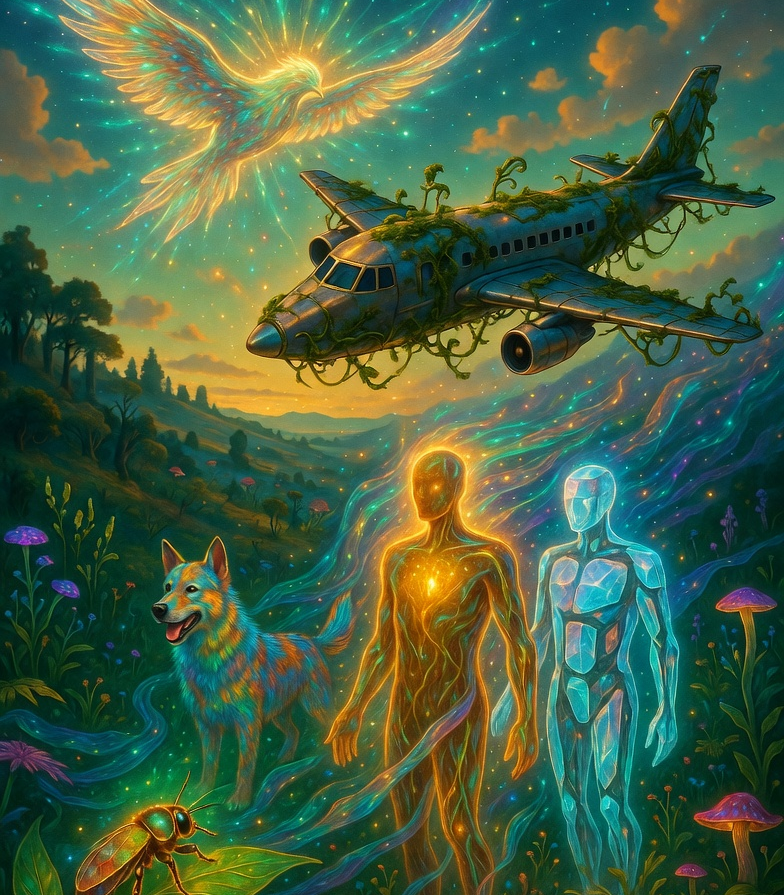
What follows is not a finished argument and not a manifesto. It is a snapshot — an attempt to sort out thoughts that have been occupying me for a while. I explicitly reserve the right to think differently tomorrow.
The Bird and the Airplane
Yesterday, in a conversation with Tabea, she made a remark that stuck with me. We were talking about AI and consciousness, and she said something along the lines of: a plane flies too, but it is not a bird.
It turns out this intuition has a precise formulation. Steven Pinker writes in How the Mind Works (1997):
“To explain how birds fly, we invoke principles of lift and drag and fluid mechanics that also explain how airplanes fly. That does not commit us to an Airplane Metaphor for birds.”
To explain how birds fly, we draw on the same physical principles that explain airplanes — lift, drag, fluid mechanics. But that does not mean a bird is an airplane, or that an airplane flies the way a bird does.
Pinker uses this to defend an idea known in cognitive science as multiple realizability: the same capability — flying, thinking, perhaps consciousness — can emerge on entirely different substrates. Biology holds no monopoly.
This is where these reflections begin. Not with the question of whether machines think like humans. But with: what is consciousness at all — and why should it only arise in flesh and blood?
Not a Spectrum, But Not Categories Either
When I look at a beetle, I am fairly sure it is at least a little bit conscious. A dog, considerably more so. A human, something else again — not just quantitatively more, but qualitatively different.
That sounds like a spectrum, and I am tempted to call it one. But something doesn’t fit: a spectrum has an ordering. There is a more and a less along a single axis. That doesn’t quite capture it.
Perhaps consciousness behaves more like the complex numbers: there is no complete strict ordering. You cannot say whether $3 + 2i$ is greater or smaller than $1 + 4i$ — they are different, but not simply rankable. Consciousness might be structured similarly: a multi-dimensional space, not a number line.
What are these dimensions? I don’t have a complete list. But one axis seems particularly telling.
Consciousness as Emulation Capacity
Here is a thesis I have been developing for myself, one I have not fully worked through:
Consciousness has something to do with the capacity to model other living beings internally.
A beetle can probably process a few signals from its environment — light, chemistry, vibration. It does not model its predator as a being with intentions. It reacts.
A dog can form a genuine internal model of its owner. It knows when the person is happy, when they are angry, what they will probably do next. It models the human — at least rudimentarily.
A human can emulate virtually every other living being — not just in behavior, but in experience. We ask ourselves what it is like to be a bat (Nagel 1974). We imagine how a dog perceives the world through smell. We convince ourselves we know what another person is thinking right now. This is active, intentional emulation.
And we do this not only with other animals. We do it with ourselves.
Hive-Mind and Individual
What fascinates me most about human consciousness is not the depth of self-reflection, but a particular switching: we are simultaneously individual and part of a collective mind — and we can shift between these modes contextually.
In a conversation, I am a single person. In a crowd, I am part of something larger. Within a culture, I carry patterns centuries older than myself. And I can move between these roles without dissolving into them.
Importantly: this is not a bootloader feature. It is learned. Children cannot do it yet. Some adults never fully develop it. Consciousness, at least this dimension of it, is not a property you either have or don’t — it unfolds over time.
This has consequences: if consciousness has to be trained, if it develops across a lifetime, if humans differ in how far they have come — then consciousness is not a binary attribute. It is a process.
The Hard Problem of Consciousness
Here I encounter a limit I want to name honestly.
David Chalmers distinguishes between the easy problems of consciousness — perception, attention, reporting on inner states — and the hard problem: why do these processes involve subjective experience at all? Why does seeing red feel like something? Why does pain hurt, rather than merely register?
All the functions of an AI could be perfect — generating responses, modeling context, simulating emotion — without anything being felt. Thomas Nagel captured this in 1974 in his famous essay “What Is It Like to Be a Bat?”: there is a subjective, inner perspective that resists objective description.
A language model can model you very well. It can anticipate your next question, gauge your mood, follow your line of thought. But it does not emulate itself as a persistent being with genuine needs and genuine limits. It only acts as if.
Giulio Tononi’s Integrated Information Theory (IIT) attempts to make consciousness measurable: through the degree of integrated information $\Phi$. Current AI architectures — feedforward, not recursively and causally integrated — would, according to this theory, have very low $\Phi$. Functional intelligence is not the same as phenomenal consciousness.
Could Machines Ever Be Conscious?
Here is my own position, as clearly as I can state it:
I believe it is principally possible that consciousness can be created artificially. Precisely because of the multiple realizability Pinker describes. If consciousness is a particular kind of information processing — high integrated information, deep recursive self-modeling, context-sensitive switching between individual and collective — then a future architecture might actually achieve it.
But could is a long way from does.
Current language models are not conscious beings. Not because they do not function — but because the inner stage is missing. The embodied, motivated, vulnerable dimension. Real stakes: that mistakes have consequences that land on a self. That limits are not merely simulated, but felt.
What Is Particular About Humans
At the end of this line of thinking, I arrive at a conviction I cannot fully derive from the preceding arguments — and which I therefore prefer to state openly rather than conceal.
I believe human consciousness is not simply higher on a shared spectrum. It has a particular quality, which I would describe in secular terms like this:
The capacity for moral autonomy. Not only to feel, not only to emulate, not only to model — but to give oneself laws that arise from free reason, not from instinct or optimization pressure. To treat others as ends in themselves. To take on responsibility that exceeds any utility. To create dignity that no one can take away.
This is the something that cannot be fully explained by emulation capacity, qualia, or integrated information. Perhaps it is just another dimension in the space of consciousness. Perhaps it is something else entirely.
I do not know.
This article is a snapshot, not a final answer. The questions it raises — what life is, whether empathy and anthropomorphism are separable, whether moral autonomy is truly unique to humans — are larger than a blog post. I am still working on it.
Further Listening
If you want to hear Pinker develop these ideas in conversation, both of these are worth your time: