Post the Wrong Answer. You'll Learn More.
Someone on Quora asked: “Murphy’s Law states that the best way to get the right answer on the internet is not to ask a question, it’s to post the wrong answer. What are some examples where you applied this law?”
The first reply: “This is Cunningham’s Law and not Murphy’s Law.”
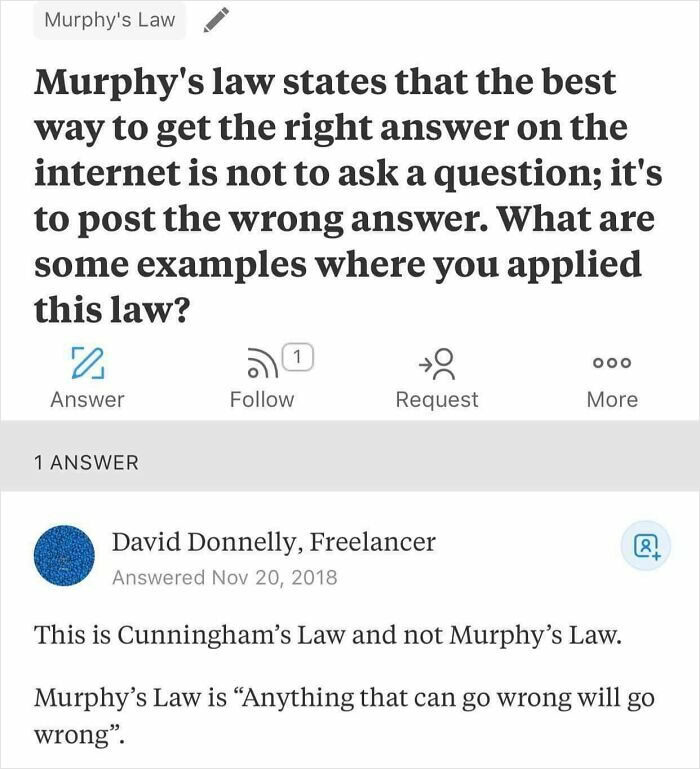
The correction proves the law. Whoever posted that question, intentionally or not, ran the most elegant demonstration possible.
What Cunningham’s Law Actually Says
Ward Cunningham, the programmer who invented the wiki, is credited with the observation: the best way to get the right answer on the internet is not to ask a question but to post the wrong answer.
It works because of a deep asymmetry in human motivation. Watching someone be wrong activates something in most people that a politely phrased question does not. A question is a request. A wrong statement is an affront. The correction impulse is faster, more reliable, and far less susceptible to the bystander effect than the helping impulse.
This is not a cynical observation. It is a useful one.
I Have Been Doing This By Accident
Some time ago I published a piece arguing that physics does not explain anything, it only describes. I posted it mostly because I had been carrying the thought around for a while and wanted to write it down in a form that someone could push back on.
On Xiaohongshu, the comments were good. Several people with actual philosophy of science backgrounds wrote in to sharpen the distinction between description and explanation, point me toward literature I had not read, and challenge the parts where my framing was loose. I was wrong in places. I am less wrong now. That exchange would not have happened if I had published a tentative, heavily hedged version of the piece that signalled I was not sure about any of it.
The post did what I wanted it to do: it attracted people who knew more than me.
This happens in person too. A few days ago I was talking to Meihui Huang, a physicist who had just given a presentation on neutrino oscillations. She mentioned that during the talk, someone had asked why a particular graph showed a sharp peak around 6 PeV. When she told me about it, I immediately started arguing that the most likely explanation was blazars: their jets produce a fairly narrow energy distribution, so if you detect them they can look nearly monoenergetic. I was confident. I was wrong.
She listened, thought about it, and later that night sent me a message pointing out the Glashow resonance. At that moment I realised I had not been looking at an energy spectrum of detected events at all. I had been looking at a diagram of the effective cross section. Two completely different things. I found the paper, read it, and corrected my understanding.
I felt bad for having argued so freely about something I had misread. And at the same time I felt genuine relief, the specific relief of being a little less wrong than I was the day before. That relief is what I am actually after.
Popper’s Shadow
There is a serious idea underneath the joke.
Karl Popper argued that falsifiability is the boundary between science and non-science. A claim that cannot be tested against reality, that cannot, in principle, be shown to be wrong, is not a scientific claim. You learn nothing from a theory that cannot fail.
The same logic applies to arguments. A half-formed thought you keep entirely to yourself cannot be corrected. It sits there, unchallenged, and you gradually mistake its familiarity for its correctness. Publishing it, even when it is rough, gives it the chance to fail. And when it fails in front of people who know things you do not, you gain something a longer incubation period would never have given you.
I am not recommending bad faith. Posting a deliberately wrong statement to generate traffic is a different thing entirely, and I do not find it interesting as a practice. What I am recommending is publishing the thought at the stage where you actually hold it, rather than waiting for a confidence that the subject matter may never justify. Silicon Valley packaged this idea into slogans: “fail fast”, “move fast and break things”, “failing forward”. The slogans got mocked, partly because companies used them to excuse genuine carelessness. But the underlying principle is not wrong. Readiness is often a feeling, not a state. Waiting for it means waiting indefinitely while someone else does the thing imperfectly and learns from it. Your failures, published early, are more educational than your polished conclusions published late.
The Practical Consequence
Most of what I publish here is half-cooked. I mean that as a statement of fact, not an apology. I write when I have something I want to think through out loud, not when I have arrived at a settled conclusion. Settled conclusions rarely need writing down. The unsettled ones do.
If something here is wrong, I want to know. Not because being corrected is pleasant, but because it is the only reliable mechanism I have for closing the gap between what I think I understand and what I actually understand. The gap is always larger than it feels from the inside.
You can start by leaving a comment. Maybe you should try it too one day.